 Meet MarshGazers

UCL East / 2025–26 / Olympus Rover Trials Advanced Stream
Olympus Advanced
From looking to collecting.
01 / The mission
The next mission: bring a piece of Mars back.
The Advanced Stream brief moved from reconnaissance to sampling. In the Airbus Mars Yard, the rover was tasked with reaching designated collection sites, acquiring regolith and returning it to an analyser at the landing zone, for up to three sites within a 30-minute mission window.
02 / Our starting point
Taking the next step.
Our second season combined returning MarshGazers with new recruits. The ambition grew with the team: a four-wheeled sampling rover, a RASSOR-inspired bucket drum and a largely autonomous architecture, backed by supervised teleoperation for recovery.
My part in the team.
Sean captained the second season, with Dami and me as vice captains. As Mechanical Subteam Lead, I led concept selection, mobility and sampling architecture, and CAD and CAM work in Autodesk Fusion 360, while communicating build plans and trade-offs with supervisors and workshop stakeholders.
03 / Engineering the mission
Make every subsystem serve the sample.
Move through loose sand.
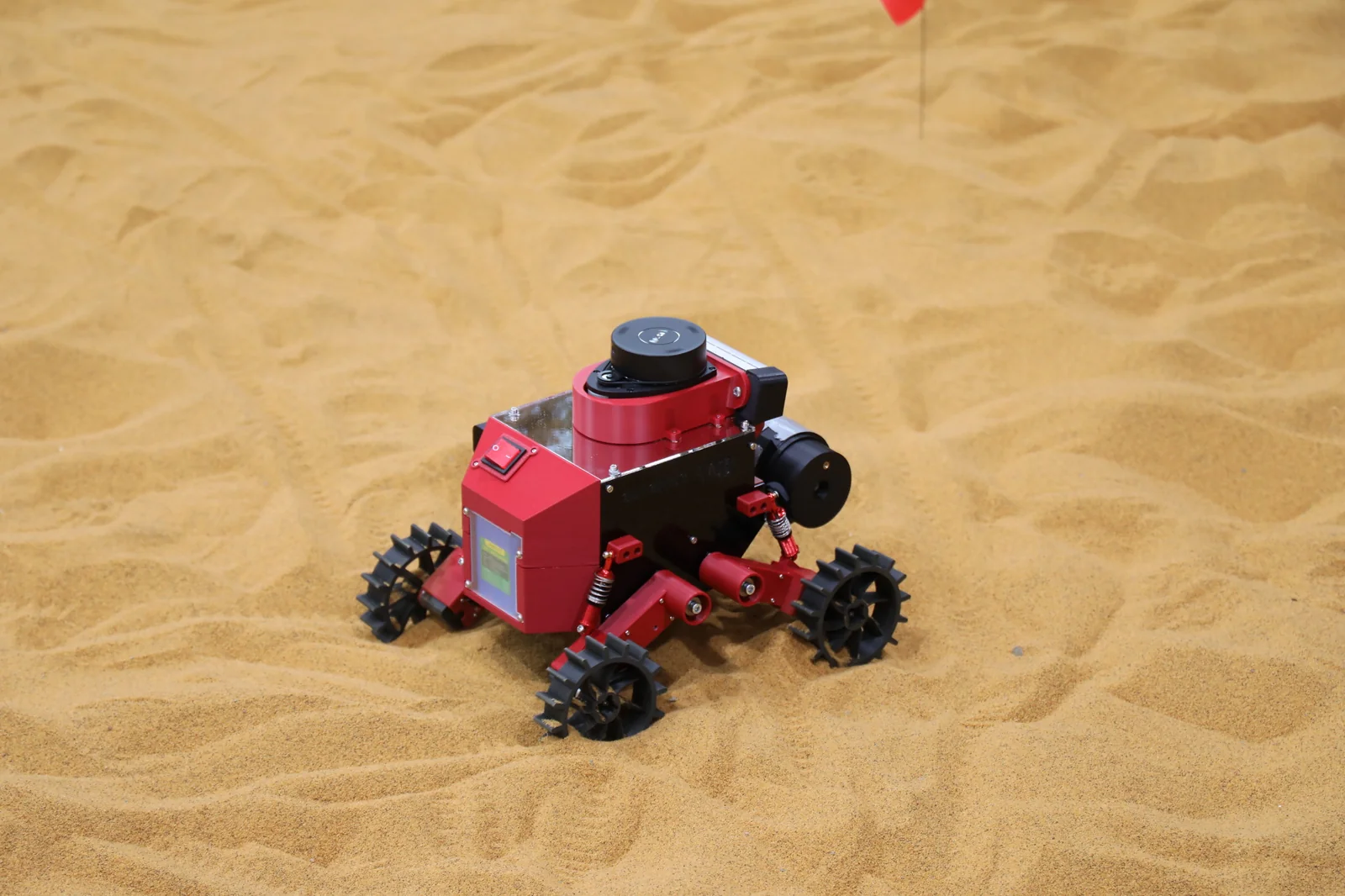
We selected four-wheel skid-steer mobility with deep-tread wheels. The mechanical challenge was to package a rover that could traverse soft terrain while carrying the sampling system and onboard electronics.
Collect, carry, deposit.
The sampling design drew on the RASSOR principle: counter-rotating bucket drums working in loose regolith. I led adaptation of the concept to our manufacturing resources and the competition's collection and deposition constraints.
Design towards autonomy.
The mission architecture targeted onboard localisation and mapping, path planning and obstacle avoidance, with supervised teleoperation as a recovery mode. These were design goals; a fully autonomous end-to-end mission is not claimed here.
04 / From team to terrain
The build, frame by frame.
Follow the hardware, preparation and competition story. Select a frame for the closer look.
01 / 06
05 / What we took forward
A design recognised.
We placed third nationally and won Best Critical Design Review (CDR), scoring 89/100. Our Preliminary Design Report had also received 73/100, a Grade A. The photographs show the final hardware and field preparation behind that design work.
What the season taught us.
Moving from a camera rover to a sampling system meant coordinating mobility, excavation, sensing and software around one mission. The available evidence supports the design work, assembled vehicle and review award; it does not establish a measured autonomous sampling success rate.