IBM Consulting / Summer internship / June–September 2026
A brief.
A team.
A winning play.
Data & Insights Consultant Intern
Twelve weeks exploring how agentic AI could help consultants turn a client challenge into a useful digital experience.
My most recent work experience. For my full experience and CV, get in touch ↗.
01 / The people and the brief
Sport brings people together.
So should its digital experiences.
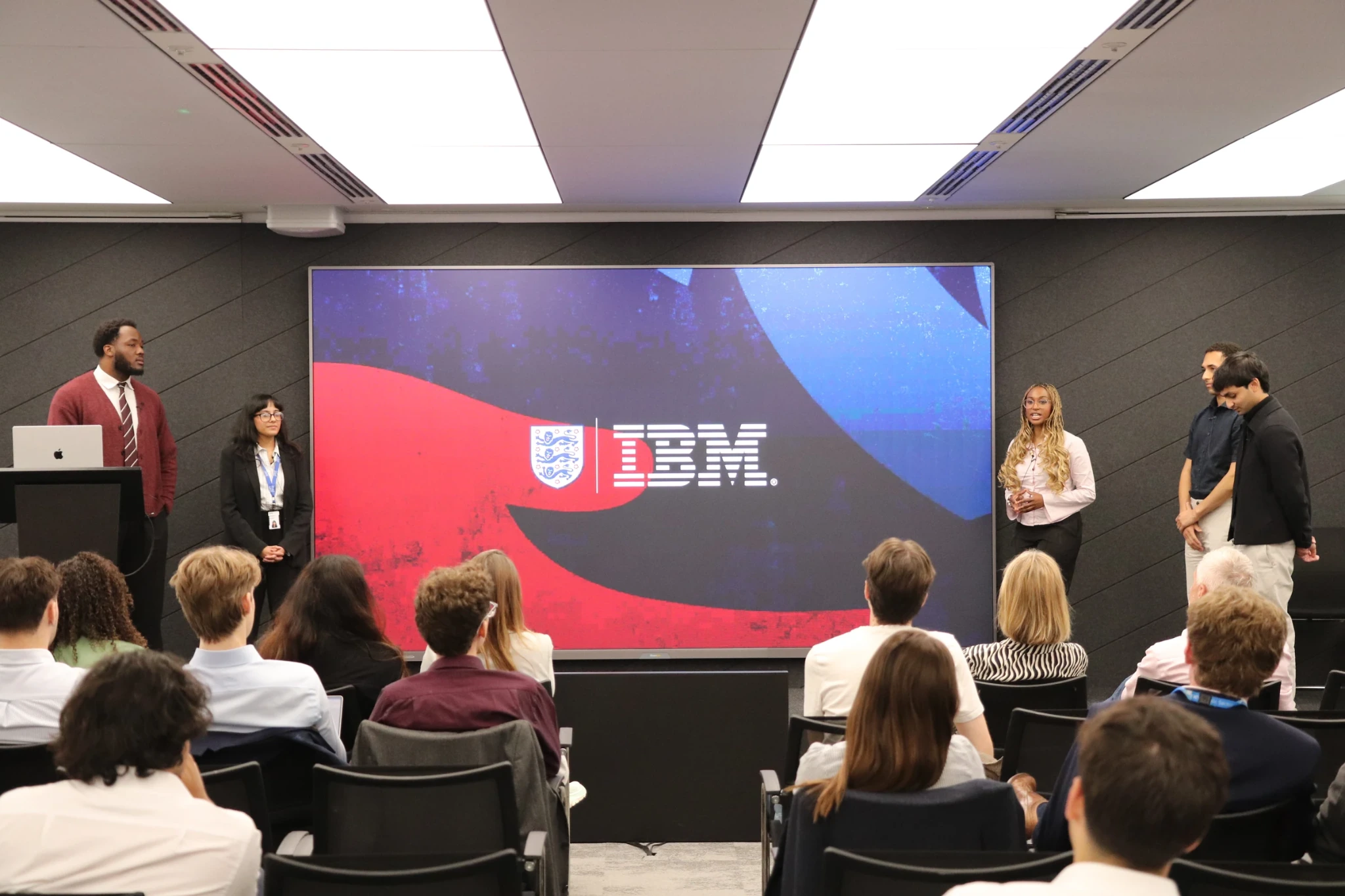
I joined IBM Consulting’s Communications team, working in its sport and entertainment space, from 29 June to 18 September 2026. Our five-person intern team worked across business, technology and design on a challenge involving the official England Football App.
My role in the team.
As a Data & Insights Consultant Intern, I contributed across research, business analysis, technical solutions and product design. That meant connecting evidence about the client and its users with the features we explored, and helping structure a workflow that could be reused.
IBM’s existing sports work, including Ferrari, Wimbledon and the US Open, gave the challenge its wider context. Fred Baker asked us to explore how agentic AI could enhance established ways of working while preserving consultant expertise, quality and human oversight.
02 / Two problems to solve
A better feature.
A better way to get there.
We started by brainstorming opportunities for the app: what did different supporters need, where did the current experience create friction, and which ideas were worth pursuing? At the same time, we asked how agents and assistants could support the work we were doing to answer those questions.
Could we use an agentic approach to address a real FA digital challenge, while keeping IBM quality?
Could the same approach become useful across other sport and entertainment clients?
03 / Understanding the work
Reel it back in.
Map the whole journey.
The Product Development Lifecycle takes an idea through research, requirements, design, development and testing towards launch. After a pivot, we had only a couple of weeks to produce a working proof of concept. We needed to identify concrete places for AI support, rather than try to accelerate everything at once.
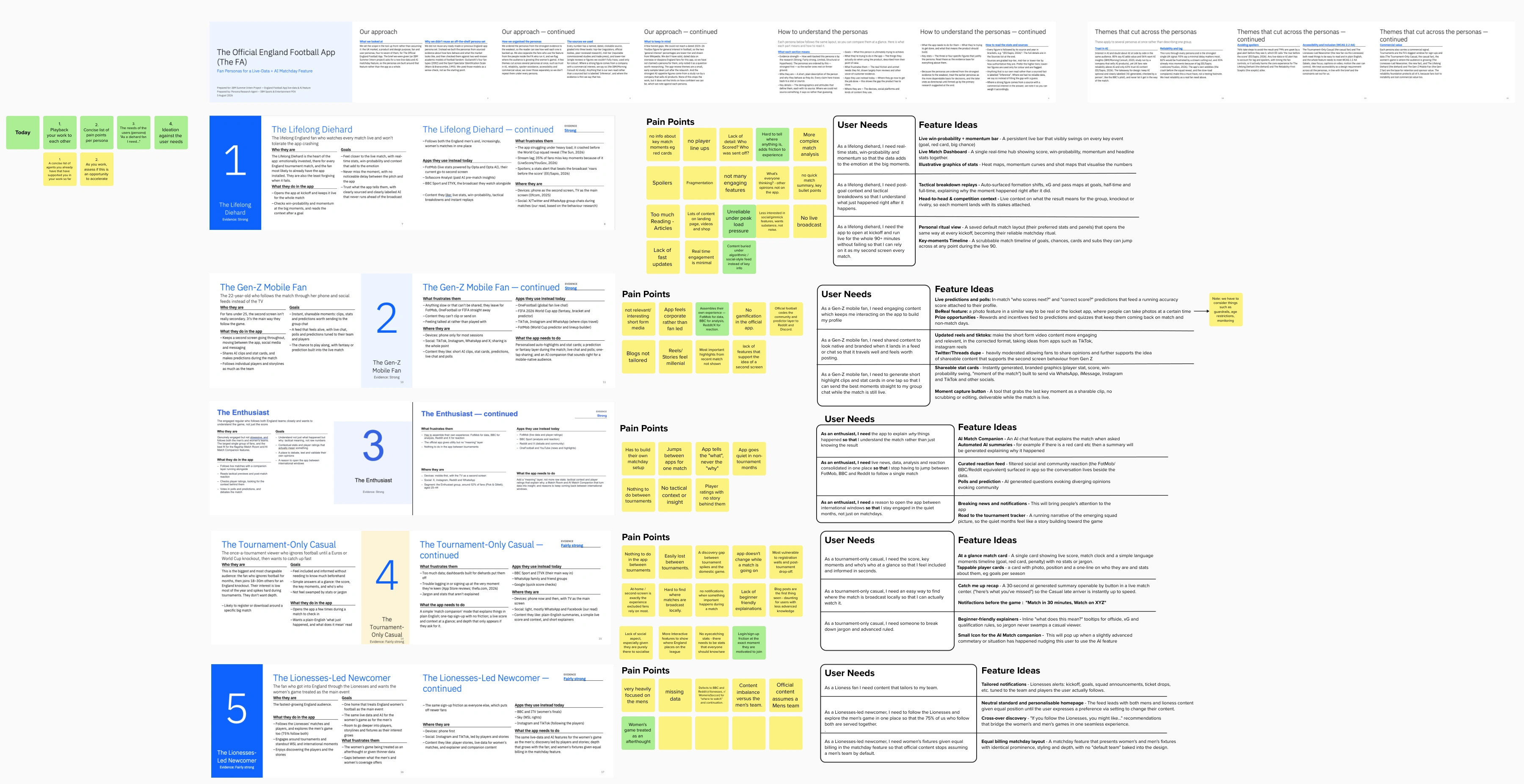
Start with the supporter.
Personas, pain points and feature ideas brought into one shared board.
Open full PDF ↗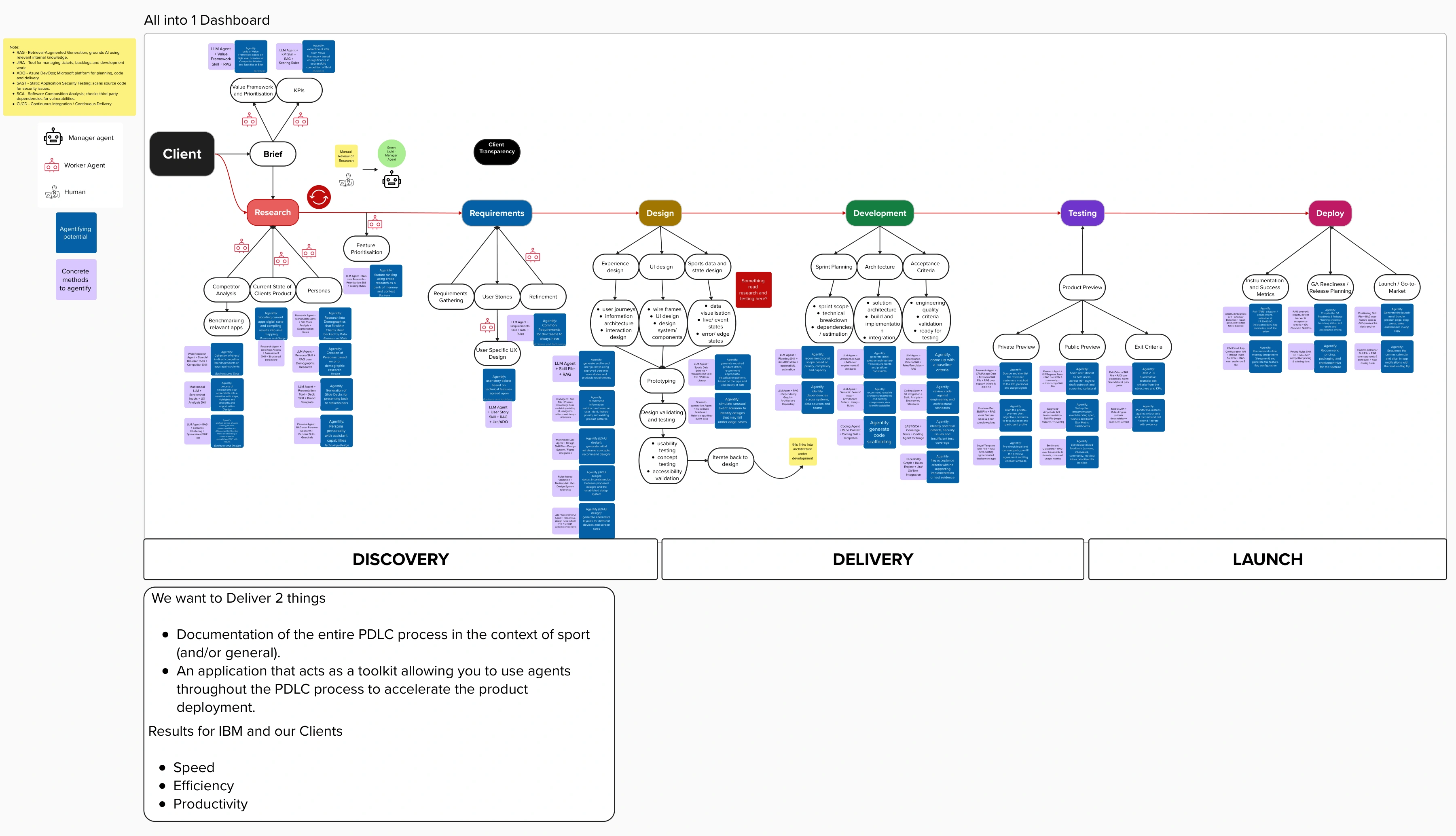
Map the work behind the feature.
A shared map of discovery, delivery and launch, with human review in the loop.
Open full PDF ↗Eight touchpoints for AI in the loop.
Discovery / 01
Market analysis and benchmarking
Understand the landscape.
Discovery / 02
Current app experience
Understand what is already there.
Discovery / 03
Personas
Understand who we are designing for.
Discovery / 04
Requirements
Turn insight into a clear brief.
Delivery / 05
User stories and journeys
Describe the experience we want.
Delivery / 06
Design and architecture
Give the solution a structure.
Delivery / 07
Acceptance criteria
Define what good looks like.
Delivery / 08
Feature development
Bring the selected idea to life.
04 / The toolkit

Playmaker.
An Agentic Product Development Toolkit for Sport & Entertainment.
From client brief to reviewed work.
Playmaker is a client-engagement workspace built around the lifecycle we mapped. A brief starts the project; agents draft artifacts such as research, personas, requirements, user stories, design concepts and code; a person reviews them before approved work is passed to the next stage.
Keep the consultant in the loop.
The toolkit combines AI agents, automation and human review. Work can be approved or sent back for changes, making the consultant’s judgement part of the process rather than something added at the end.
We packaged our ways of working into a repeatable asset, alongside applying them to a football app proof of concept. The aim was faster delivery with quality preserved; we did not establish a quantified speed improvement.
- 01
Brief
Start with the client problem.
- 02
Draft
Let an agent prepare the artifact.
- 03
Review
Approve it or request changes.
- 04
Build on it
Use approved work downstream.
01 / 01
05 / The starting experience
The app we began with.
The existing app provided editorial coverage and detailed written reports. Our ideation explored how to complement that with match information supporters could scan and understand more quickly.
01 / 02
06 / What we created
A more visual matchday.
These five screens are from our team’s England app proof of concept, created using Playmaker with human intervention and refinement. Fixtures, concise insights, line-ups, visual statistics and player browsing demonstrate the approach in practice.
01 / 05
07 / Bringing it together
Show the product.
Explain the process.
We finished with an interactive app proof of concept, a reusable toolkit and a showcase of the thinking behind both. For me, it was an opportunity to work as a consultant across the full journey, keeping the user’s needs, the client’s challenge and the wider team connected.
01 / 03
A team effort.
Built with Benjamin Segall, Valerie Fiamavle, Vidhisha Chadda and Ahmad R.
With the challenge and support from Fred Baker; guidance and feedback from Ben Gilpin, Georgia Smith and Jessica Harding; and support throughout the internship from Louise Keevill.