UCL / First Year, Final Term Challenge
Tree Climbing Robot
Climb a tree. Place a canopy sensor. Find a way back down.
01 / The challenge
Before the next step,
earn the next grip.
Our first-year final-term project asked us to build a robot that could climb a tree, deploy a sensor in the canopy and return to the ground. Between April and June 2024, the team worked towards a final showdown. Every upward movement depended on the same question: could the robot hold on while part of it moved?
Two grips.
One climbing cycle.
We developed alternating upper and lower grippers linked by a lead-screw mechanism. One section would hold the trunk while the other advanced, then the grip would transfer for the next movement.
My role in the build.
I led the design and mechatronics work, taking the mechanism through rapid prototyping and troubleshooting. Guide-rod support, centre of mass and gripper actuation all became part of the iteration as we worked towards a system we could demonstrate.
02 / Let the prototype teach us
A lighter way to hold on.
Begin with rigid fingers.
Our earlier concepts used rigid fingers and servo actuation. Acrylic and plywood options added mass and did not give us the behaviour we wanted.
Move towards compliance.
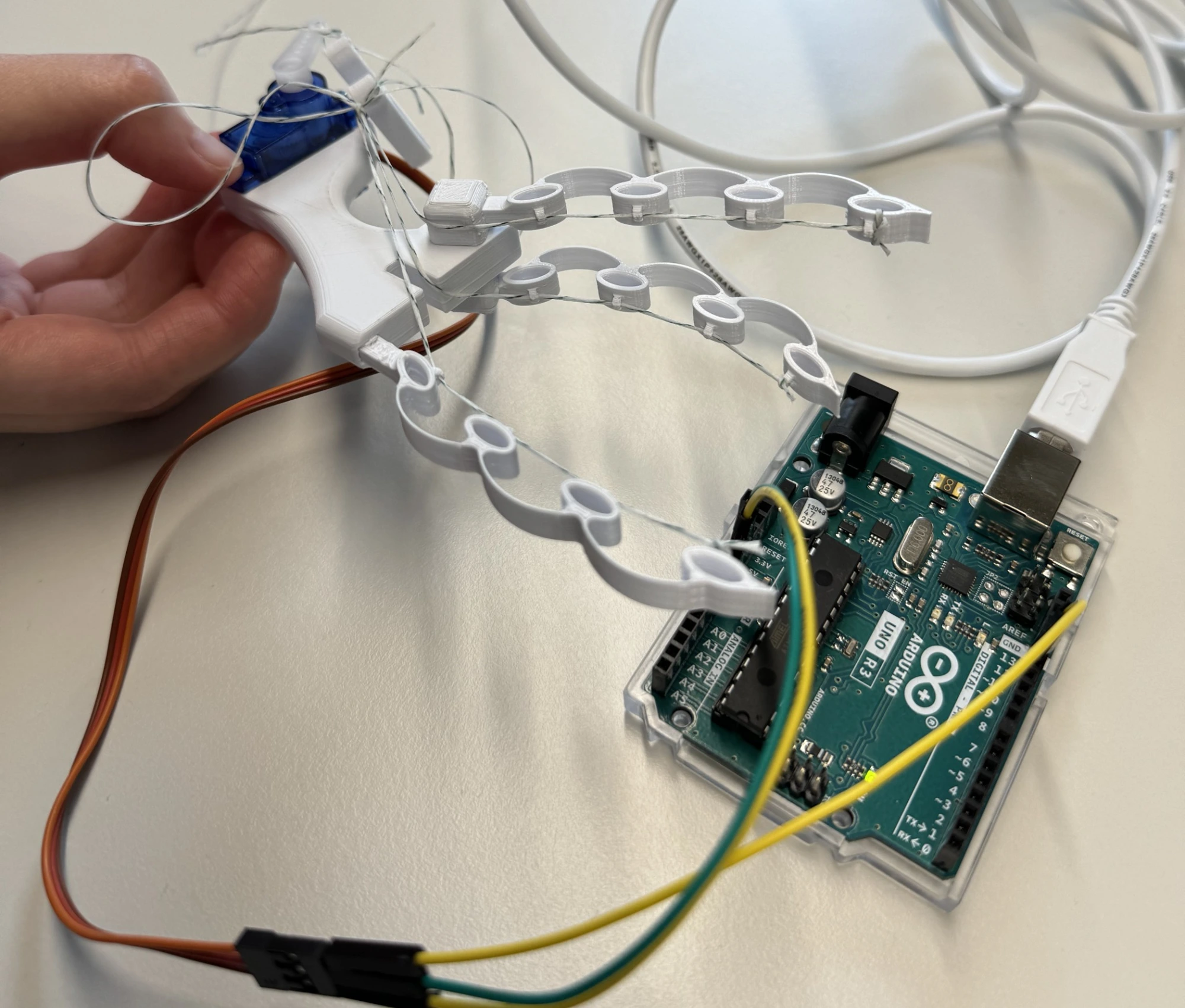
We developed lighter compliant PLA fingers, actuated by strings. Their flexibility allowed the later gripper to adapt to the trunk and hold it in a working demonstration.
Keep the whole system in view.
A workable gripper was only one part of the climb. The body support, balance and lead-screw motion also had to work together, and ascent remained slower than we intended.
03 / Concept to compliant prototype
The build, frame by frame.
Follow the sketches, drawings and physical iterations. Select an image for the closer story.
01 / 10
04 / What we achieved
A grip that worked.
A climb to improve.
The compliant gripper adapted to and held the trunk in a working demonstration. The overall result was a partial success: ascent was slower than planned, and we did not demonstrate the complete climb, sensor deployment and return.
The lesson I took forward.
The project showed me how quickly a promising mechanism becomes a system problem. Making a finger lighter changed the load on the climbing mechanism; changing the body support affected the grip. Iterating with the physical prototype helped connect those decisions.