UCL / Third Year Group Project
Assistive Exoskeleton
Exploring how twisted string actuation could help with one everyday movement: getting up from a chair.
Standing up.
Holding on to independence.
Could a wearable lend a hand with an everyday movement?
01 / Begin with the person
An everyday movement. A design challenge.
Our third-year UCL group project explored sit-to-stand assistance from October 2025 to June 2026. The aim was a wearable that could support the transition from sitting to standing, with older adults and everyday independence at the centre of the idea.
Start with a reason to build.
My contribution began with researching existing assistive products, user needs and use cases. I compared approaches through the literature, considered physical constraints and translated that evidence into requirements and evaluation benchmarks.
I maintained a structured evidence base so the team could trace design decisions back to the problem we were trying to solve.
Connect the body to the mechanism.
I worked in the mechanical team, alongside a separate simulation team. The project brought together wearable placement, attachment, string routing and sensing, with the aim of making the actuator's pull useful during the movement.
The research had to shape the build: where the device would sit, how force would reach the leg, and what meaningful assistance would need to look like.
02 / The mechanism
Small strings.
A different kind of pull.
A twisted string actuator, or TSA, turns a motor's rotation into a pulling motion. As the strings twist together, their effective length shortens. The idea was to route that pull through a wearable to explore assistance around the knee.
The mechanism gave us a question to investigate: how could its contraction, placement and timing work together during sit-to-stand?
Read about twisted string actuation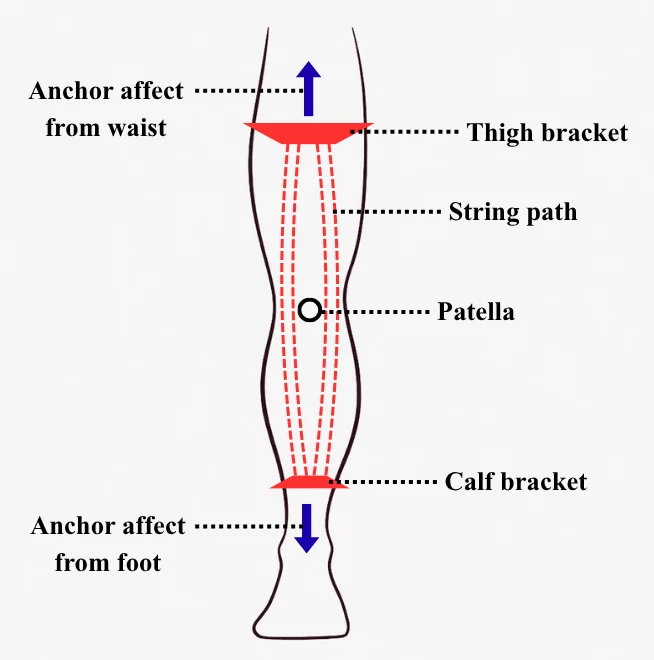
01 / Rotate
The motor turns.
Motor rotation twists the strings, providing the input to the mechanism.
02 / Contract
The strings shorten.
Twisting changes the bundle's geometry and reduces its effective length, creating a pulling motion.
03 / Transmit
The wearable carries the pull.
The brackets and string route connect the mechanism to the body. Their geometry is part of the assistive design, alongside the actuator itself.
03 / From movement to wearable
The build, frame by frame.
Follow the movement references, team CAD, string routing, assembled wearable and sensing setup. Select a frame for a larger view and the story behind it.
01 / 14
04 / Bringing it together
A prototype to learn from.
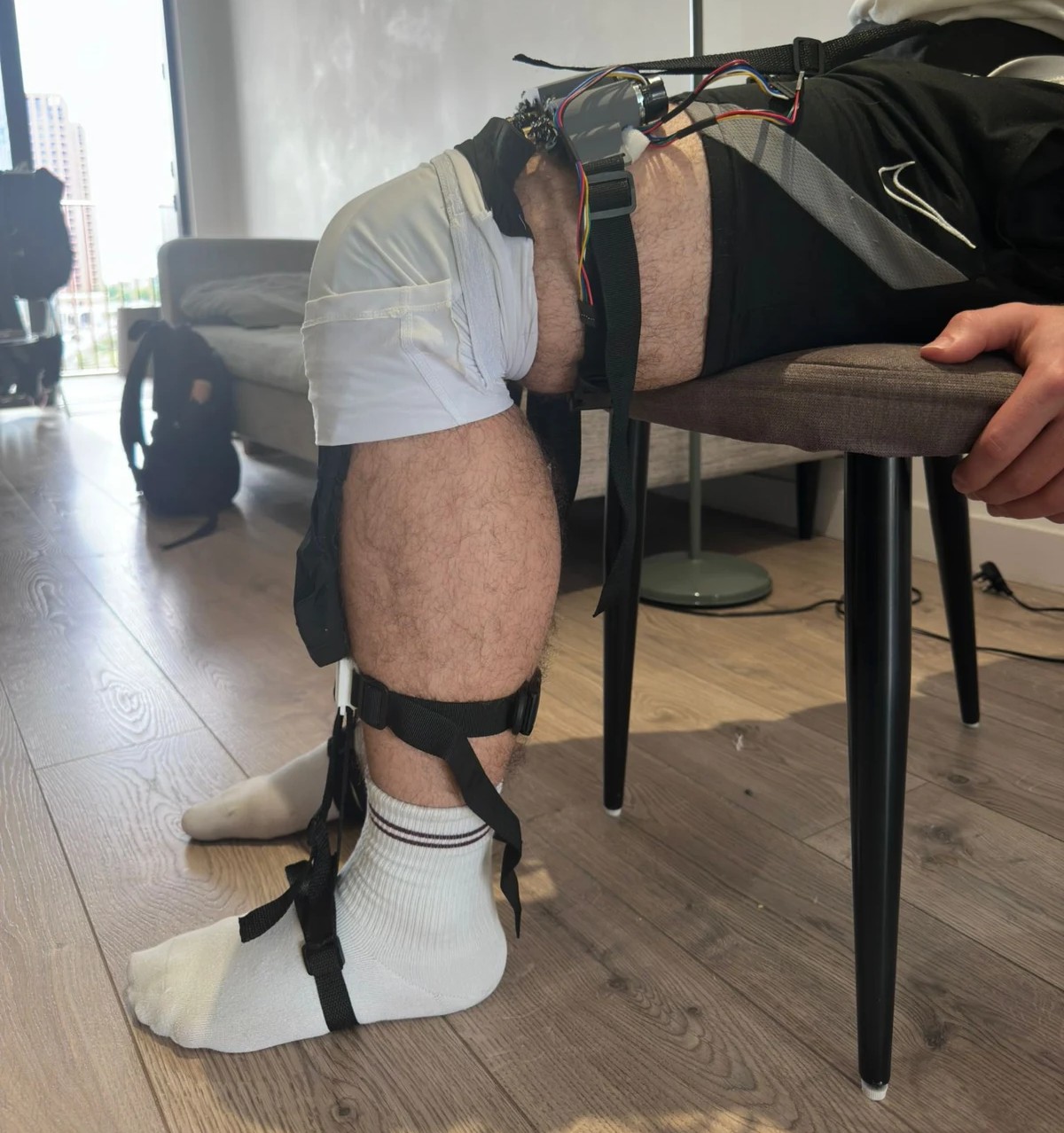
The team brought body-mounted brackets, string routing and sensing work into a wearable research prototype. The CAD and assembly photographs show how an assistive idea became a physical system.
The next question is how consistently that system can deliver useful assistance: measuring force, timing, comfort and repeatability during the movement.
Keep the purpose in view.
For me, the project connected research and requirements with the practical questions of building something a person would wear. A mechanism is only part of that story. Its value depends on how well the whole product responds to the movement and the person using it.
The work reinforced the need to evaluate assistance as a whole: the pull of the mechanism, its timing, the comfort of the attachments and the experience of the wearer.